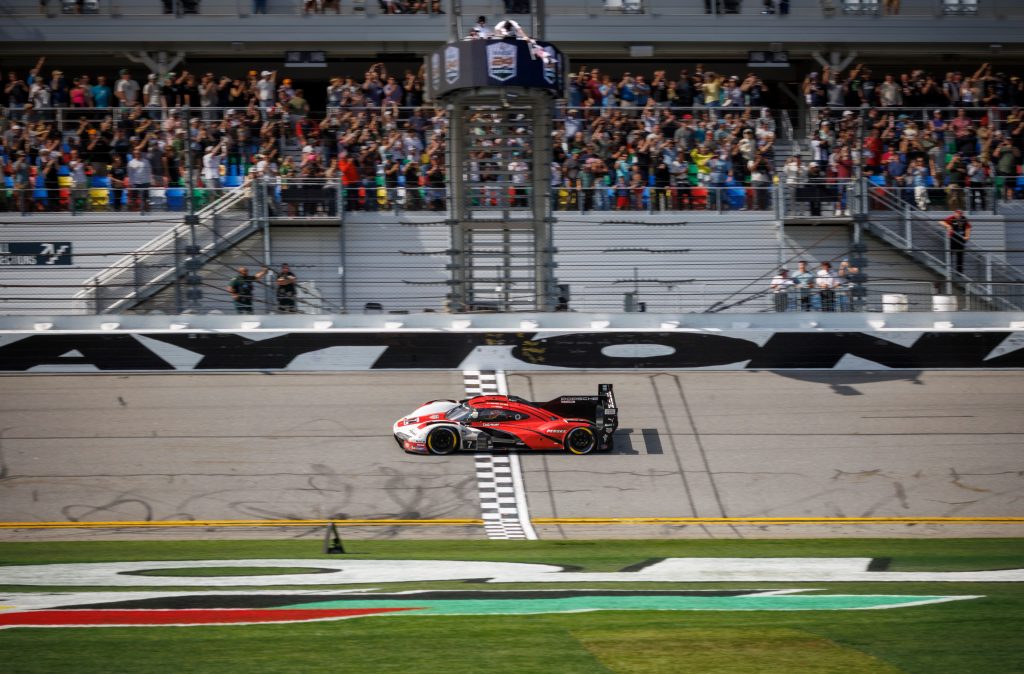
While this victory adds another accolade to Penske’s 650 major race wins and 48 championships, the prize for this race isn’t just any hardware that will sit on a shelf in Mooresville. It is the most coveted trophy in motorsport: the winner’s Rolex Cosmograph Daytona.
Jenson Button said that many drivers enter the race specifically for the chance to win the coveted timepiece. As a Formula One champion, he’s held trophies most racers can only dream about and stood on podiums at Monaco, Spa, and Silverstone. Still, he acknowledges that he returns to Daytona for a shot at wearing that watch. Jenson attended the race this year as a Rolex ambassador, not a competitor, and has yet to garner the elusive prize that draws talent from Formula One, IndyCar, NASCAR, WEC, and beyond.

When Rolex became title sponsor in 1992, the company formalized the tradition of awarding the specially engraved watches to the champions in each racing class. Rolex understood that endurance racing was a test of time and saw a sponsorship tie-in that would remain significant decades later. This year’s watch carries added significance, as Rolex celebrates the 100th anniversary of the Oyster, the world’s first waterproof wristwatch and the foundation for the Daytona.
The Cosmograph Daytona has evolved many times since 1963, when Rolex introduced it as a purpose-built chronograph designed for motorsport professionals. It was the first watch equipped with a tachymetric scale on the bezel to measure average speed over time intervals, making it a functional tool for drivers and teams who needed to record elapsed time and speed with precision.
In 1988, Rolex introduced the first self-winding Daytona, sourcing a high-frequency chronograph movement from rival watchmaker, Zenith. By 2000, Rolex had built its first entirely in-house chronograph movement, establishing its independence in manufacturing. The new movement featured fewer components, better shock resistance, and a longer power reserve, allowing it to run for 72 hours off-wrist. By 2015, Rolex’s standards were tighter than the official Swiss chronometer certification, regulated to Rolex’s proprietary Superlative Chronometer standards, which guarantee accuracy within −2/+2 seconds per day.
The Daytona’s 60th anniversary in 2023 brought refined case lines, a mounted bezel, and thinner lugs while keeping the core dimensions. The watch was now offered in a variety of material combinations including Oystersteel, gold, and platinum, with dials in a variety of colored metals, lacquer, and meteorite.
Winners of the 2026 Rolex 24 at Daytona received a Rolex Cosmograph Daytona reference 126503, in Rolesor, a combination of stainless steel and yellow gold. The watch features a white dial with gold-trimmed subdials, a yellow gold bezel engraved with the tachymeter scale, and an Oystersteel bracelet with polished gold center links.

Rolex brings approximately 20 watches to Daytona each year to account for potential winners across four classes. The watches arrive already engraved with the Rolex 24 logo, the word WINNER, and the year, each engraved in Rolex’s New York office by a single watchmaker. Arriving at the track in an armored car and held under tight security, Rolex ensures that each winner receives theirs in Victory Lane along with the champagne celebration.
The watch has become part of racing lore. Tom Kristensen once said, “Ask anyone in the motorsports world to name a watch and the first to be mentioned is bound to be the Rolex Daytona. It has a history and class around it that everyone trying to aim for the top in motor sport understands and respects.” When Ricky Taylor won in 2017 he kept the watch in its box for weeks, eating breakfast with it every morning because it didn’t seem real. A.J. Allmendinger keeps his in a drawer to look at when he needs a pick-me-up and brings it to Daytona each year as a reminder of what’s possible. Bryan Sellers, who earned his first watch after 13 starts, said it flat out: “Daytona is about one thing and one thing only. It’s just the watch. You grow up in sports car racing knowing that is the one trophy you have to win before you walk away.“
One of the most iconic moments in the Rolex 24 tradition came in 1995. At 70 years old, Paul Newman drove a Roush Racing Ford Mustang to a GT-1 class victory, making him the oldest driver to receive the winner’s watch. Newman had already become inseparable from the Rolex Daytona. He wore his personal watch constantly, a creamy dial with black subcounters that would later become known as the Paul Newman Daytona. It became a reference point in watch design, a shorthand for lived-in elegance. That watch sold at auction in 2017 for $17.8 million, setting the record for the most expensive wristwatch ever sold.
Today’s Rolex 24 winner’s watch retails for around $12,000, if you could buy it, but teams will spend millions racing to win one. Collectors approach winners regularly, sometimes with absurdly generous offers, for their engraved watches. And the answer is always no. Always. Because once you understand what the watch represents, you cannot separate the watch from the experience of earning it, from the months of planning, preparation, and practice, and the 24 grueling hours of racing that came before Victory Lane. Selling it would be selling proof that one has achieved greatness at the highest level of motorsport, and you can’t put a price on that.
Daytona International Speedway and Rolex extended their partnership last week, keeping Rolex as title sponsor and official timepiece of the Rolex 24. Frank Kelleher, president of Daytona International Speedway, said the speedway is honored to extend its partnership with a company that has been dedicated to Daytona and racing for decades. Luca Bernasconi, president and CEO of Rolex Watch USA, echoed that, calling Daytona the spiritual home of Rolex’s nearly century-long involvement in motorsport. For the foreseeable future, Rolex will continue marking defining moments at the racetrack and will remain motorsport’s most sought-after prize.