
In 7th grade my hairdryer broke. A normal family would have purchased a new one. Not us. I had to take it apart to see if I could identify what wasn’t working. When I opened it up and saw the broken heating coil, I was kind of proud of myself. We wrote to the manufacturer to get a replacement part and instructions. About FIVE WEEKS LATER, it arrived in the mail and we were able to swap out the part. For a middle school girl, 5 weeks without a hairdryer was the worst thing ever, and I resented my dad for not getting me a new one. Decades later, I don’t know how to relate to people who don’t even think to fix things. I wonder who will fix the world as interest in trades declines.
Most high schoolers don’t aspire to fix things. They don’t think about how to build things. They sit in their algebra or physics class and don’t see any real world application. Ask any of them if they want to be a Quantitative Analyst or a Composite Tech when they grow up and you’ll likely get a disinterested nod. Tell them those are jobs on a Hypercar racing team and the attitude changes.
That’s exactly what IMSA set out to do. The series partnered with Gainbridge, Konica Minolta, and EVERFI to create a free curriculum that connects what students learn in class to what happens at the race track. EVERFI works with more than 60,000 teachers and schools across the country, providing interactive, game-based lessons on STEM careers, including engineering careers in auto racing. The goal is simple: show students where their skills can take them.

For its inaugural cohort, teachers from Florida’s Spruce Creek and Atlantic High Schools selected 27 students based on their interest and commitment to STEM subjects. 16-year-old Sebastian Ray Serpa was one of those students. He’s into mechanical engineering, specifically biomechanical work on how joints function.
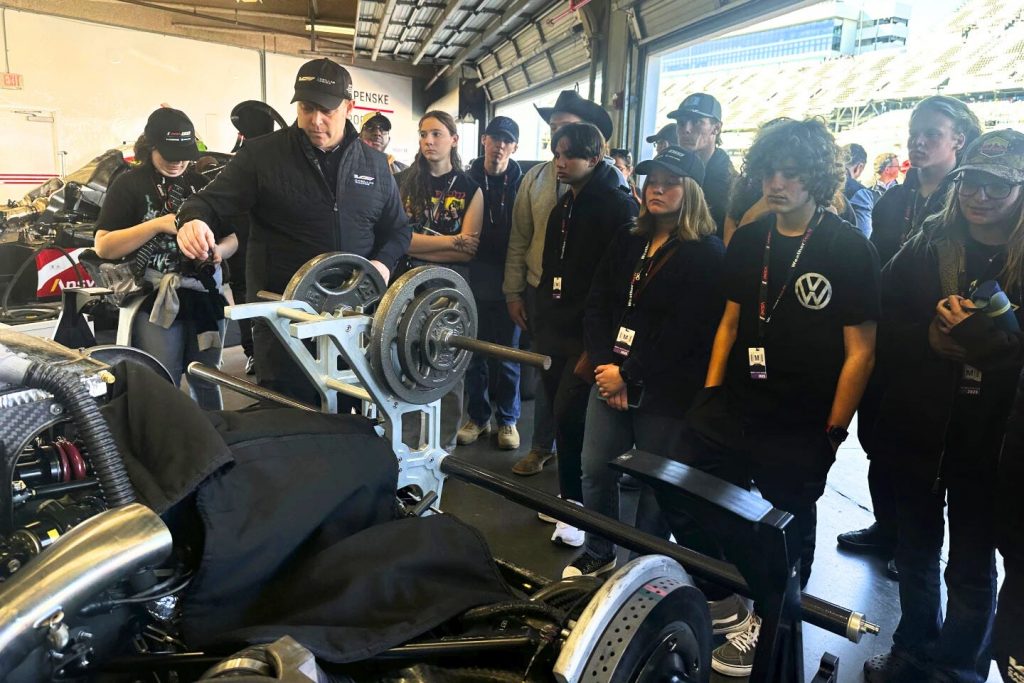
Sebastian drives past Daytona International Speedway all the time, but he’d never been inside. This past January, he finally got on track. Sebastian walked into DIS during the Roar Before the 24 to a paddock full of high performance vehicles and the teams who support them. IMSA President John Doonan told the students how algebra, calculus, physics, and chemistry were being applied at the track at that moment, introducing the student to a series of work stations where they could experience STEM in action.
“What we’re doing here is a laboratory. It’s a laboratory for the automakers. It’s a laboratory for Michelin on the tire front. It’s a laboratory for all these teams. For the students to be able to see what they’re doing in the classroom be applied in a real-world environment, that gives me and all of my IMSA teammates a lot of satisfaction. These students here, some of the top students from the Volusia County schools surrounding the Daytona area, they’re our future.”
At the Michelin Tire Center, Sebastian learned how grip, friction, and heat cycles determine which tire works at which temperature. The physics he does in class translates to how Michelin engineers figure out which compound holds the track in which conditions. At the IMSA Engineering Center, he watched data stream in from sensors all over the car. Engineers explained how they use those numbers to make decisions that determine the strategy for how to approach the circuit and when to stop for tires, fuel, and maintenance. At Tech Inspection, he held safety gear in his hands and learned about impact resistance and heat tolerance and how these tools save lives.
At the Action Express garage, he stood next to the No. 31 Cadillac V-Series.R hybrid race car and heard from Chris Mitchum, the team’s director of operations, Aaron Pfeifer, Cadillac’s LMDh tech lead and Jim Fowler, IMSA’s supervising official. That’s what changed everything: he heard from real people who studied STEM subjects and ended up in logistics, marketing, data science, and jobs he didn’t know existed.
“This has been a real eye-opener for me,” Sebastian told the AP. “I knew that behind almost every concept out there there were opportunities, but I never realized how wide that actually went. There are so many applications that require STEM skills.”
Amy Monahan, a K-12 STEM Specialist for Volusia County Schools, is excited about the program. “Some of them think the military or trade jobs are all that is available to them,” she said. “They don’t know. Most of them have never been to a race, so seeing this and what it looks like, and understanding there are plenty of things to pursue is just a wonderful gift for them.”
In a post-program survey, students who went through the program increased their knowledge of engineering careers by 65 percentage points. Ninety-three percent identified career paths they didn’t know existed before. Forty-nine percent said they’re now interested in pursuing a career in auto racing. In 2025, 180 students attended six on-site programs, and the program reached more than 14,000 students across 420 schools with nearly 500 teachers through the free online curriculum.
For John Doonan, the first event wasn’t about the numbers, though. For him, it was a moment of personal accomplishment. “I’m so proud that we could kick this off this year,” he said. “It’s something that I think is incredibly important for the entire sport”
The program was recently renewed for the 2026 season at 6 venues:
- Daytona International Speedway during the Roar Before the 24, January 16-18
- Sebring International Raceway, March 21
- Long Beach Grand Prix, April 18
- WeatherTech Raceway Laguna Seca, May 3
- Detroit Grand Prix, June 1
- Indianapolis Motor Speedway, September 20
For more information:
https://everfi.com/courses/k-12/building-moving-stem-careers/